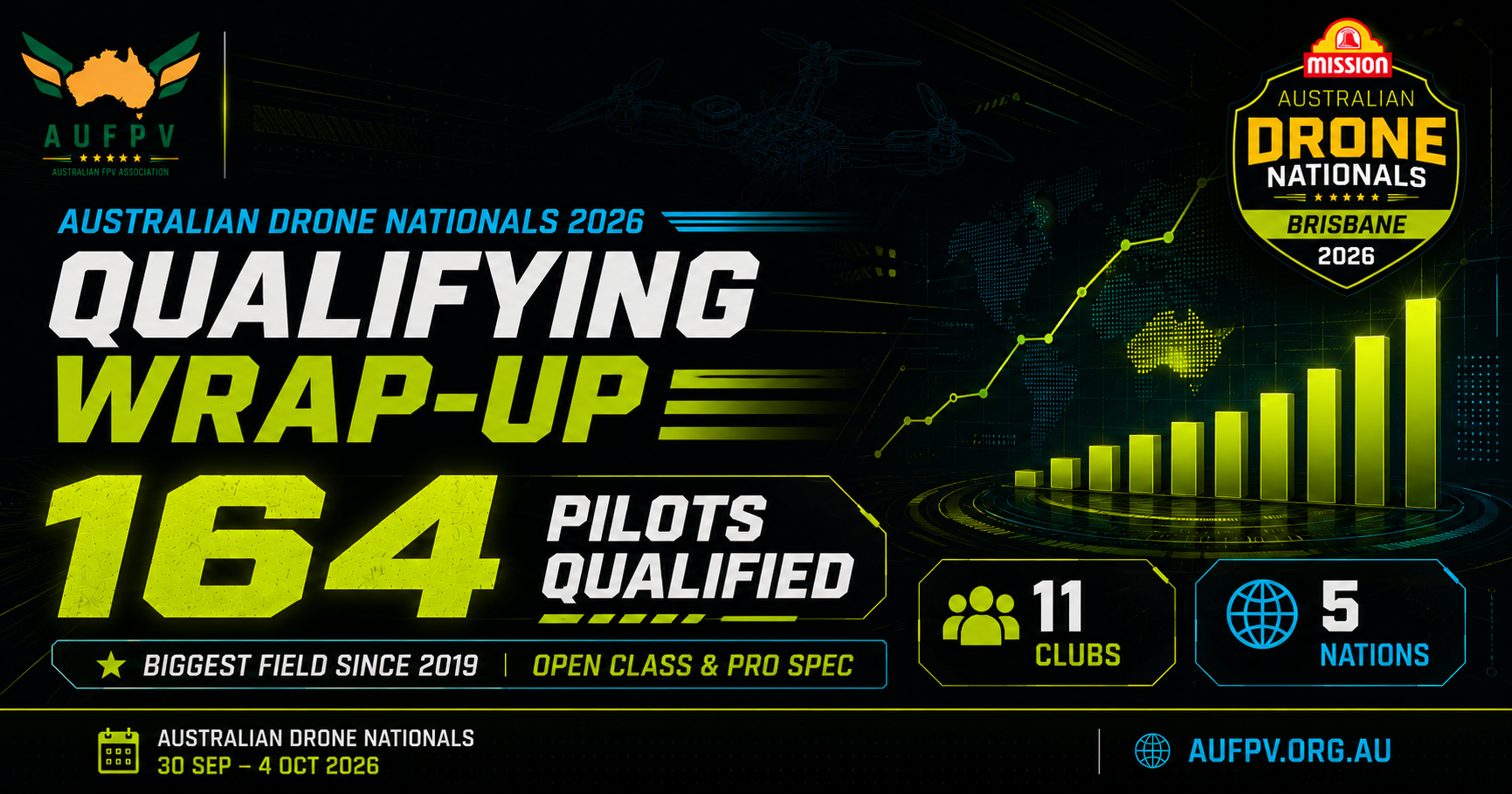
Qualifying for the Australian Drone Nationals 2026 officially closed on 30 June, and the numbers are in. What started as a trickle of DVR submissions back in autumn finished as one of the deepest national fields we've seen — 164 pilots have locked in a time, from every corner of the country.
With the Nationals set for 30 September – 4 October 2026, here's how qualifying played out.
Open Class — 164 pilots and all the speed!
Open Class was the headline act, and the pace at the top was relentless right to the deadline. IQ0 held the TQ spot for the majority of the qualifying period until flowerpig, from South Korea entered the fray with a time that is sure to shake up the competition and put Australian pilots on notice.
Qualifying Snapshot
- 164 pilots qualified
- flowerpig (South Korea) set the fastest lap of the entire campaign — a blistering 25.38s
- The top three were separated by just 1.05 seconds — flowerpig (25.38s), IQ0 (26.39s) and BMSThomas (26.43s)
- 29 pilots broke the 35-second barrier and 12 went sub-30 — the depth at the sharp end is serious
- Pilots flew in from 11 clubs and 5 nations
The state-by-state spread shows just how national this field is: the ACT (35) leads narrowly, but NSW (30), Queensland (27), Victoria (18), WA (15) and South Australia (12) are all deep — plus 12 international pilots making the trip.
And they're not here to make up the numbers. 15 international pilots qualified in Open Class — 9 from New Zealand, 3 from China, plus one each from South Korea, the United States and Taiwan — and they landed right at the sharp end. Three of the six fastest laps of the entire campaign came from overseas: flowerpig (South Korea) topped the lot at 25.38s, with Screecher (USA, 27.10s) and Sloogus (New Zealand, 27.15s) both inside the top six. Could this be the first Australian Drone National's Open Class who is not an Australian?
It's a broadening field in another way too: 12 female pilots have qualified across the grid. It's still a minority, but the number is growing, and year on year Australia continues lead the way and grow female participation in the sport. This year female participants account for 7.3% of all competitors - close to doubling the number from 2025.
Pro Spec — The great equaliser
The popularity of ProSpec in Australia continues to grow. From 32 pilots in 2025, we have seen 52 pilots put times on the leaderboard in which positions to make the Top 48 are now closely fought over.
Qualifying Snapshot
- 52 pilots qualified
- Wubbz (Outer Heaven) took the fastest time at 43.38s — just edging out clubmate Fizz (43.39s) by a single hundredth of a second
- IQ0 made it a top-three within 0.30s at 43.68s
- 13 pilots dipped under 50 seconds
- 10 clubs represented
Everyone of our ProSpec pilots also qualified for Open Class, but with positions tight for Open Class - we may see some pilots only racing the big bright drones at this year Nationals.
The clubs bringing the numbers
Canberra Multirotor Racing Club top the qualifier count with 27 across the field, followed by ADF Drone Racing (25), Outer Heaven Drone Racing (22) and FPV Rebels (18) — with Eastside FPV, Adelaide FPV Racing, West Coast Multirotor Club, Melbourne Multirotor Club, Rotorcross, Townsville FPVR and Panorama Drone Racing all putting pilots on the board. The Canberra Club in particular continues to grow and grow, accounting for 21% of the overall field, this is an amazing achievement when you consider back in 2019 when Canberra hosted Drone Nationals they only contributed 11% of the pilots.
Most improved & the grinders who never stopped
Qualifying isn't just always about who is the fasted, its a chance to gauge your performance amoungst your peers, to set a goal and work towards it and a chance to improve your overall racing skill. Right up to the deadline, pilots were flying their DVR laps again and again, shaving fractions (and sometimes whole seconds) off their times. Across Open Class, 51 pilots resubmitted a faster time, knocking off an average of nearly 7 seconds each from where they started.
Most improved — biggest gains from first time to last
- YHzero (Adelaide FPV Racing) posted the single biggest turnaround of the whole campaign — 94.87s down to 48.18s, a 46.69-second improvement
- Aussie Dog FPV (CMRC) was right there with him: 100.21s to 53.90s (−46.31s)
- Panda FPV (CMRC) — 96.54s to 71.02s(−25.52s)
- D1NGO (Eastside FPV) dropped 70.54s to 46.65s (−23.89s)
- Subb20 (Adelaide FPV Racing) hauled from 56.41s down to 33.95s (−22.46s) — the fastest finish of the big improvers, and genuinely competitive territory
Over in Pro Spec, Nacho (CMRC) led the improvers, going 67.89s to 57.75s (−10.14s), with Whodeany and Dellogator both finding 6+ seconds.
The grinders — most submissions on the board
Some pilots simply refused to settle, resubmitting again and again:
- tex (FPV Rebels) is the undisputed grinder of the campaign — five Open submissions chipping his way from 49.60s to **41.75s**, then a Pro Spec campaign on top taking him to a total of eight submissions over the qualifying period.
- Lucid (FPV Rebels) went back four times, 40.44s to 35.06s
- Joey (Eastside FPV) also lodged four trimming to 33.28s
- A whole pack put in three apiece — Panda FPV, Croz, digsky, TommyD and Le Star among them
- In Pro Spec, Dellogator (ADF Drone Racing) led the way with three submissions, working down to 62.81s
From pilots desperate to make the cut, to beat a mate on the leaderboard or to truely show their level of skill, these pilots didn' give up and ground at a result that we hope they were proud of.

How far the sport has come
Nationals qualifying is always a great time to take stock of the health of the sport. It provides key data on participation rates, the strength of clubs and states and can help track performance of pilots of many years. When we take this years qualifying data and compare it to previous years, one this is clear - the sport of Drone Racing in Australia is strong, is growing and in a healthy state moving forward.
2026 in context
- Four straight years of growth: since the 2022 restart the qualifying field has grown every single year — **116 → 135 → 141 → 144 → 164** — making 2026 the biggest field since 2019 (200) and the strongest of the modern era
- A loyal core and a wave of new blood: 64% of the 2026 field are returning qualifiers, while 58 pilots (36%) are qualifying for the first time since at least 2019 — the sport is recruiting as fast as it's retaining
- The ever-presents: 13 pilots have qualified at every Nationals in the modern record (2019 and 2022–2026). Several are still right at the front — six-time qualifier IQ0 put the second-fastest lap of the whole 2026 campaign on the board
- More women on the grid: female participation has climbed from 4.83%** in 2025 to 7.3% in 2026 — roughly 7 pilots up to a dozen— extending a rise AUFPV has tracked since 2022. Among them, BlondeAngel, WA has qualified at all six Nationals in the record
- A more national field: the ACT has grown from 11% of the grid in 2019 to around a fifth today — now the single biggest bloc — With South Australia also growing, showing a shift from traditionally strong heartlands like Sydney, Melbourne and Brisbane.
- Increased International Pilots: 15 International pilots qualified in 2026 the highest on record, indicating that the Australian Drone Nationals is fast becoming one of the worlds premier drone racing events.

What's next
Qualifying seats are locked. Invitations are going out, and the countdown to 30 September is on. To everyone who put down a time — Congratulations on your efforts. To everyone who's coming to watch: this is going to be a nationals to remember, you won't want to miss a second.
Spread the word to your club.